call at: (248)602-2682 OR Schedule a time to meet with Peter: Sonareon Schedule
Call us and get a Free Executive AI Briefing

Anthropic’s Terms & Conditions Just Became a Courtroom Lesson
Claude and privacy and understanding the terms you agree to when using AI tooling is paramount. USA vs. Heppner ruling reveals a critical truth most professionals don't think about: your AI prompts and outputs aren’t private. More importantly, we cover the essential steps to think about when using these tools.
2/18/20262 min read
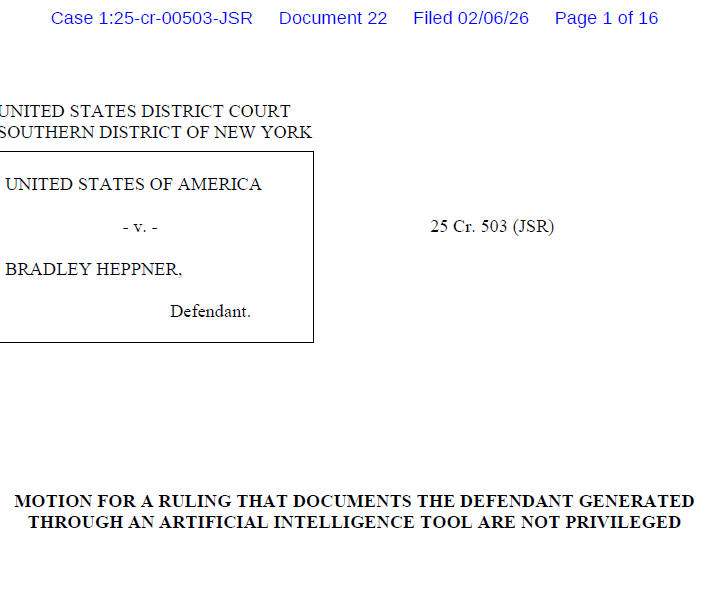
Working in a regulated industry (banking) has given me one habit I can't turn off: I read the Terms and Conditions before I click anything. Most people don't. There is a lot of legalese and who has got the time for that? I get it; however, the recent US vs Heppner ruling explains, in everyday language, why this matters more than we realize.
When you use a commercial AI tool such as Claude, ChatGPT, or any of the others, your prompts and outputs are stored on an infrastructure you don't own, governed by policies you agreed to and most likely, never read.
If the data does not live within your enterprise, someone else has rights to that data. You are no longer in control.
In the court case the documents references the defendant utilizing Claude to shape his legal strategy. He made the argument that the AI documents are privileged.
The court's reasoning rested on a simple premise: Anthropic told users exactly what it was doing with their data. Users agreed to those terms. No reasonable expectation of privacy survives that combination. Here are the three disclosures that drove the ruling.
1. Claude's Constitution explicitly disclaims legal advice
Claude calls their framework a "Constitution" as it is a foundation, set of principles that guide AI behavior. Claude is explicitly programmed to give responses that "least give the impression of providing specific legal advice." When asked directly, the model states it "cannot give legal advice" and directs users to "consult with a qualified attorney." The disclaimer isn't buried—it's baked into the model's behavior.
2. Anthropic's Privacy Policy (in effect at the time) states:GovernmentRulingonAIEvidencePrivacy.pdf
At the time of the case, Anthropic's Privacy Policy stated clearly that it collects data on:
Prompts entered by users
Outputs generated by the model
That data is used to train the AI and may be disclosed to "governmental regulatory authorities" and "third parties." This is not fine print hidden in an appendix, it is a primary disclosure.
3. No confidentiality exists
The court ruled there's zero expectation of privacy when using Claude (or similar AI tools) because the defendant "voluntarily shared his queries with the AI tool," that Anthropic is a "third-party commercial platform" that is "publicly accessible," and that users have a "diminished privacy interest in conversations with an AI tool which users voluntarily disclosed."
You shared it. It's gone. You should have zero expectation of privacy.
I am not making an argument against using AI tools just because you may be in a regulated environment. The point is to use them with awareness of the data goes and what rights you retain over it.
What this mean in your Organizations
CPA Firm: Have a current Written Information Security Plan (WISP).
Understand how to better secure the AI tools you are using
Ask yourself, where does your data live?
Does the vendor use your prompts and outputs to train their models
Is there an on-premise or private cloud deployment option that keeps the data within your perimeter?
Develop the muscle memory I developed in banking. Pause, read the Terms, understand the data flow before installing or using AI or any free AI tooling.
(Sonareon does a full AI Audit asking the questions above and many others in order to safeguard your enterprise and the customers you serve.)
Connect
Email: info@sonareon.com
© 2025 Sonareon. All rights reserved.
Phone: (248-602-2682
Schedule a time to meet: Sonareon Schedule
Phone: 248-429-9110
Sonar is a way to navigate objects by listening; hence the name Sonareon
Sonareon Privacy Policy