call at: (248)602-2682 OR Schedule a time to meet with Peter: Sonareon Schedule
Call us and get a Free Executive AI Briefing
Tax Scams: IRS is a movie buff
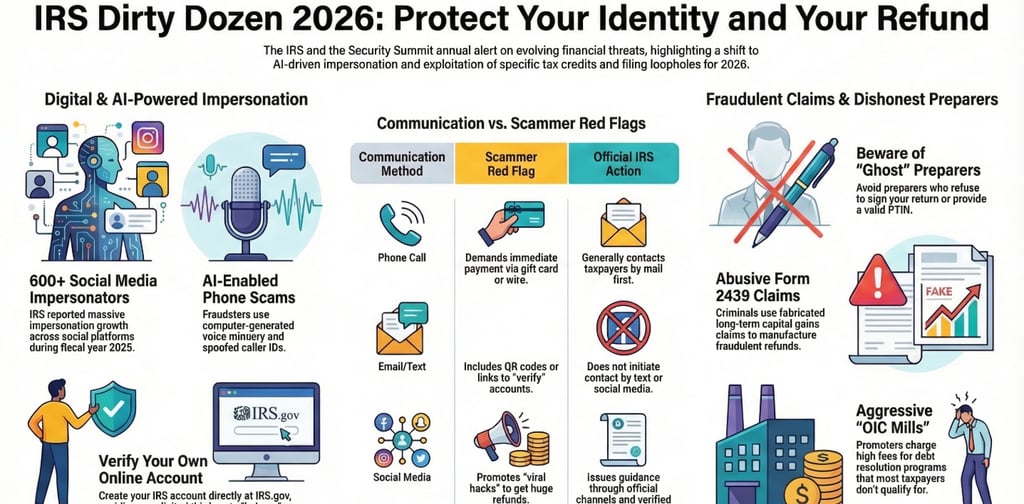
The IRS released its annual lists of evolving tax schemes called the Dirty Dozen on March 5. This is a great list for Everyone! A picture is worth a thousand words so via NotebookLM here is an infographic along with some humor to cement these scams into our memory muscle.
Peter Serzo
3/11/20263 min read
Given the fact that the IRS called this the Dirty Dozen means that the person who put this together is older and possibly a movie buff and realizes that catchy names catch attention. None of that takes away from the importance of this post, as a taxpayer or if you work in a CPA firm, in the financial services world dealing with PII information, or if you are in a profession like Cyber Security.
On March 5 the IRS released their annual list of tax scams for 2026. This is an excellent reminder for all of us to be vigilant about scams. Read the post located here. I created the picture above with my favorite AI tool, NotebookLM, to pictorially represent.
What is powerful about this list and how the IRS named it is that this should be muscle memory for all of us. Fraud is engineered for speed. As such, being a movie person, I pulled 5 quotes from The Dirty Dozen (1967) to cement these scams into our subconscious.
“You’ve seen a general inspecting troops before haven’t you? Just walk slow, act dumb and look stupid!” Real-life parallel: Phishing & smishing. Don't click too quickly because it looks official. This is a trap. A general is deceptively smart, so are you.
“These people don’t know their enemy is the Germans. They think the enemy is their own United States Army!” Real-life parallel: Social Media & AI voice scams. Platforms like TikTok, Facebook, Instagram, and YouTube have become part of our everyday life, and where we get information, and many times we treat the sources as authoritative. They offer tax hacks that are not authentic. AI can impersonate a voice and spoof phone numbers. Verify, research. The enemy is not who you think. Consult IRS.gov and other legitimate sources.
“I don’t want to hurt you Major… You’re not gonna hurt me, I’m gonna hurt you.” Real-life parallel: Ghost preparers and malware campaigns. Scammers send document request emails with malicious links or attachments that have code to exfiltrate data. These nefarious entities set up fake charities or reach out to you with promises to reduce your debt for insane fees and false hope. Ask for their credentials. Check the IRS website for valid charities. Do not click unknown attachments and use a secure portal. Not email for sensitive data.
“This war was not started for your private gratification, and you can be damned sure it’s not being run for your personal convenience, either!” Real-life parallel: "I deserve this refund." This is a great reminder that one should not abuse refundable credits, withholding, bogus self-employment tax credits, or inflate appraisals of donations. All leading to improper claims. These may get you a bigger refund initially, but serve as red flags on your tax returns.
“Train them! Excite them! Arm them!” Real-life parallel: Training yourself, training your staff. The IRS ties this list to the National Slam the Scam Day, which is D-Day for fraud awareness. Stories are powerful having the ability to entertain as well as educate. Share real stories with your staff, create procedures from these learnings. Build a 1-page field guide.
What is presented here is not paranoia. Every tax practitioner has seen these scams. Each one of us most likely has a personal story and certainly every single person with an email has gotten an email with a scam. Print out the dirty dozen, make your own infographic, and certain build this into your onboarding. Because scams done't time time off, neither does our vigilance.
Have questions about how to protect your practice or clients from these scams? Your engagement letter, your Written Information Security Plan (WISP), and your client education calendar are the three best places to start. Contact us today and we can assist.
Connect
Email: info@sonareon.com
© 2025 Sonareon. All rights reserved.
Phone: (248-602-2682
Schedule a time to meet: Sonareon Schedule
Phone: 248-429-9110
Sonar is a way to navigate objects by listening; hence the name Sonareon
Sonareon Privacy Policy